You look out the window and see two furry things zooming across the yard. You don’t say “a furry thing is running and another furry thing is running behind it.” You say “a cat is chasing a mouse.” Two short words, and now you know a lot. You know the mouse is scared, the cat is hungry, and in one second the mouse will dive for a hole. You have seen cats and mice so many times that each name carries a whole story.
Now look at a creek going past a rock. Water piles up in front, curls around the sides, and makes little swirls behind. That is happening in every creek in the world, but nobody gave each kind of swirl its own name. So when a computer looks at a creek, it is like you looking at the yard before you knew the words cat and mouse. Just a blurry mess of stuff moving.
Tokenizing means: chop the mess into small patches, and give each patch a name. “This patch is a swirl behind a rock.” “This patch is a wave about to break.” The names are not words you can say out loud. Each one is more like an ID card that says what shape, how fast, and which way. That is why one name can fill a whole page.
Once everything has a name, the computer can do what you did with the cat and the mouse. It looks at the names that are there now and guesses what comes next. “Swirl behind rock” is followed by “swirl stretches and breaks off.” The names become a language, and with a language you can reason about what happens next.
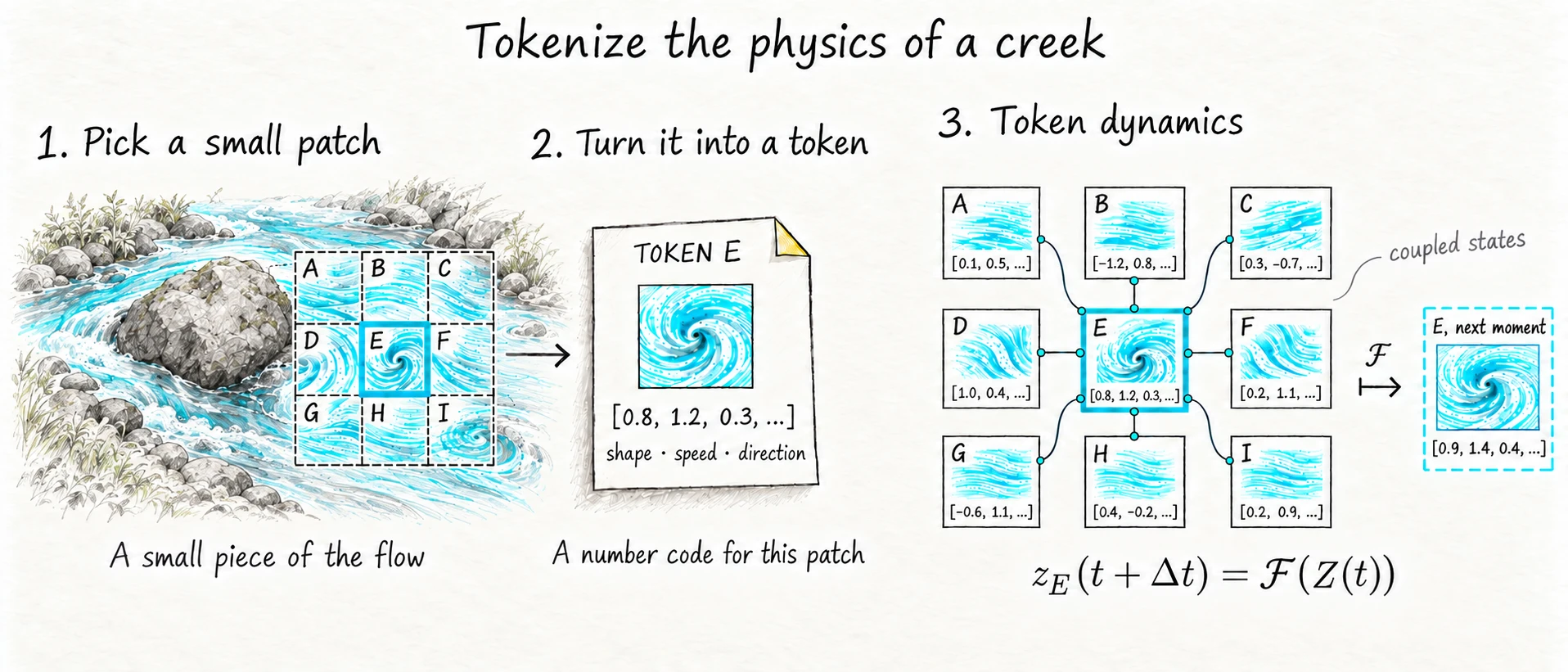
Tokenizing a creek. Each patch of water becomes a token, a list of numbers for its shape, speed, and direction. The rule F predicts a token’s next moment from its neighbors now, and it is learned from the laws of physics.
But the computer knows something you never knew about cats. Water always obeys the laws of physics, and those laws never break. So the computer learns its names from the laws, not just from watching. That is how it can tell what water will do around a rock nobody has ever seen.